What Is the Best Small Plasma Cutting Table from China?
Choosing the best small plasma cutting table from China requires more than comparing prices and cutting dimensions. A reliable decision starts with practical workshop needs, including material thickness, sheet size, production volume, and available floor space. A compact machine may fit beside a welding bench, yet still need room for ventilation, cable routing, and safe operator access.
This guide examines the features that matter during real purchasing decisions. These include gantry rigidity, cutting accuracy, torch height control, drive motors, controller compatibility, and duty cycle. A stable frame should resist vibration when the torch crosses a 6-millimeter steel plate. Water tables may reduce smoke, while downdraft systems can suit workshops with different ventilation arrangements. The best option depends on the application.
Supplier evaluation is equally important. Request test cuts using your own material, not only polished demonstration videos. Check edge squareness, slag levels, hole quality, and repeatability. Ask for electrical diagrams, spare-parts lists, operating manuals, and documented inspection procedures. Confirm that the machine can meet applicable safety and electrical requirements in your market. Certifications should be verified, not simply accepted from a product page.
No comparison is perfect. Some suppliers communicate well before payment but respond slowly after delivery. Others offer excellent frames with weak software support. That risk deserves attention. A dependable manufacturer should explain limitations honestly, provide remote troubleshooting, and support operator training. By weighing measurable performance, service reliability, and total ownership cost, buyers can identify a small plasma cutting table that performs consistently rather than merely appearing attractive in a catalog.
What Defines a Small Plasma Cutting Table?
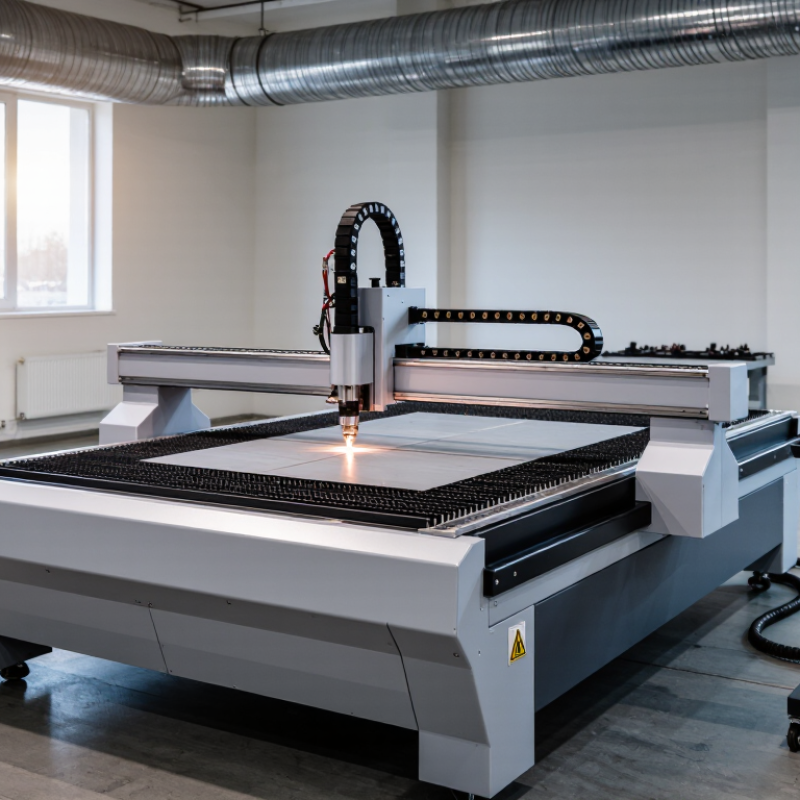
A small plasma cutting table is defined by its working footprint, not only by its price. Many compact models offer cutting areas near 600 by 900 millimeters, suitable for signs, brackets, repairs, and light fabrication. The frame should remain rigid when the torch changes direction. Otherwise, small vibrations can leave rough edges or inaccurate corners.
Small matters.
A practical table needs a stable slatted bed, reliable linear motion, and clear height adjustment. Check the rated material thickness under real cutting conditions, not only the maximum figure in a brochure. A compact air system should deliver clean, dry air at the pressure recommended by the torch manufacturer. Moisture can damage consumables and create inconsistent arcs.
Fume extraction also deserves attention, especially in enclosed workshops. A removable water tray may reduce smoke, but it adds cleaning work. I have found that this trade-off is often underestimated.
When comparing equipment from China, request cutting samples, electrical diagrams, maintenance instructions, and a clear list of included parts. Ask whether the control software supports common drawing formats and whether replacement consumables are easy to source. Inspect photographs of the cable routing, grounding point, rails, and emergency-stop circuit. These details reveal more than polished product images. A small table should fit through the workshop door and leave room for loading sheets safely. Weight, noise, installation support, and training may matter more than a slightly larger cutting area. The “best” choice is usually the one that matches daily work without forcing the operator to solve avoidable problems.
Key Features of China-Made Plasma Cutting Tables
What Is the Best Small Plasma Cutting Table from China?
China-made plasma cutting tables can offer strong value when their key features match your workshop needs. A compact table should have a rigid steel frame, accurately aligned rails, and a stable cutting surface. Even a small frame can vibrate during sharp corners. That vibration leaves rough edges and increases consumable wear.
A practical table needs adjustable torch height control. It helps maintain a steady gap above uneven steel sheets. Look for a water tray or effective extraction system to manage smoke, sparks, and heat. The tray should drain easily and resist corrosion. Reliable stepper or servo motors also matter, especially when cutting repeated shapes. A clear controller, simple file transfer, and compatible design software reduce setup errors.
In workshop checks, I examine test cuts rather than trusting photographs. A clean 10-millimeter steel cut should show limited slag and a reasonably square edge. Ask for sample results, wiring diagrams, maintenance instructions, and electrical safety documentation. Local power requirements must match the machine configuration. Confirm the cutting area, maximum plate size, torch specifications, and replacement-part availability before purchasing.
A low price can hide weak rails or poor cable protection. I would not treat every factory specification as proven performance. Independent inspection is worth considering. Small details matter, including emergency stops, grounded components, guarded moving parts, and accessible service points. Some tables perform well after careful adjustment, but that adjustment time should be included in the real budget.
How to Compare Cutting Power, Accuracy, and Work Area
What Is the Best Small Plasma Cutting Table from China?
Choosing the best small plasma cutting table depends on cutting power, accuracy, and usable work area. A practical comparison starts with the rated amperage, duty cycle, and recommended steel thickness. A table may advertise high power, yet its performance can drop during continuous work. Ask for actual cut samples, not only specification sheets. Inspect the edge, dross, piercing hole, and heat distortion. These details reveal more than a bold power rating.
Accuracy depends on the motion system, rail stiffness, torch height control, and software compatibility. Request a repeatability test on small circles and straight slots. Measure the true cutting zone, because the advertised bed size may include unusable margins.
A compact table saves floor space, but cramped loading can slow production. I have found that a slightly smaller bed sometimes works better when access is clear. Still, this judgment depends on your material sizes.
Tips: Test the table with your own steel thickness. Check the power supply, grounding requirements, spare parts, manuals, and service response. Confirm that safety guards and emergency controls meet applicable local requirements. Ask for warranty terms in writing. One weakness remains easy to overlook: performance can vary between test samples and daily production. Allow time for operator training and calibration before making a final decision.
Top Factors for Choosing the Best Model
Choosing the best small plasma cutting table from China starts with the work it must perform. Measure your usual sheet size, not your largest occasional project. A compact 600 × 900 mm bed may suit signs, brackets, and repair parts. It becomes restrictive when full panels need cutting.
Cutting capacity needs honest testing. Ask for sample cuts using your preferred steel thickness. Inspect the edge for taper, dross, and heat distortion. A stable torch-height controller matters, especially when sheets are slightly warped. Check the motion system, too. Smooth linear rails and low-backlash drives produce cleaner corners. They also reduce rework. I would not judge a machine by speed alone. Fast cutting can hide rough edges.
Power compatibility deserves careful attention. Confirm voltage, frequency, grounding requirements, and the plasma power source before ordering. A water table can control smoke and heat, but it needs drainage and regular cleaning. Dry tables are simpler, though indoor ventilation becomes more important. Ask about consumable availability, wiring diagrams, software support, and replacement parts. Supplier experience should be visible through inspection records, clear manuals, and responsive technical answers. Factory testing videos help, but they are not proof of long-term reliability. Request a live demonstration when possible. Small oversights become expensive. Also check packaging, installation guidance, warranty terms, and local service options. A lower purchase price may not remain lower after delays, missing parts, or difficult setup.
What Is the Best Small Plasma Cutting Table from China?
Top Factors for Choosing the Best Model
This chart presents a practical starting-point weighting for evaluating a small plasma cutting table. Cutting accuracy, usable work area, plasma power, and machine rigidity generally have the greatest influence on productivity and finished-part quality. The percentages are evaluation weights, not brand ratings or manufacturer test results.
Setup, Safety, Maintenance, and Operating Costs
Choosing the best small plasma cutting table from China requires more than comparing prices. Check the working area, power requirements, cutting thickness, and included software. A compact frame should arrive with clear assembly drawings, grounded electrical parts, and accessible replacement consumables. Measure your workshop before ordering. My first space estimate was too optimistic.
Safety affects both performance and cost. Use suitable eye protection, hearing protection, gloves, and local exhaust ventilation. Keep flammable materials away from sparks and store compressed gas cylinders securely. Before cutting, inspect the torch lead, earth connection, air filter, and emergency stop. Moisture in the air line can damage consumables and create rough edges. Never ignore unusual noise.
Tips: Budget for electrodes, nozzles, filters, electricity, and occasional software support. Clean the slats weekly, remove slag, and lubricate moving rails according to the manual. Record consumable life for different materials. This makes operating costs easier to predict. A small table may use less power, but slow cutting can increase labor costs. That trade-off is easy to miss. Check supplier documentation, spare-part availability, and technical response times before purchase. A low initial price is not always the lowest working cost.
What Is the Best Small Plasma Cutting Table from China? - Setup, Safety, Maintenance, and Operating Costs
| Evaluation Dimension | Recommended Specification for a Small Workshop | Typical Range or Requirement | Practical Notes |
|---|---|---|---|
| Suitable table format | Compact CNC plasma cutting table | Working area of approximately 1,300 × 2,500 mm | A compact bed can process common sheet sizes while requiring less floor space than a full industrial table. |
| Material compatibility | Mild steel, stainless steel, and aluminum | Conductive metals only | Plasma cutting is not intended for wood, plastic, glass, or other nonconductive materials. |
| Recommended cutting thickness | Best results on 1–12 mm mild steel | Thin-sheet capability may begin below 1 mm; maximum capacity depends on the plasma power source | For regular production, choose a power source with a rated capacity above the required thickness rather than operating continuously at its limit. |
| Plasma power source | Inverter plasma system with CNC interface | Approximately 45–100 A for small-table applications | Higher amperage can increase piercing and cutting capacity, but also raises electrical demand and consumable wear. |
| Drive and motion system | Dual-side synchronized drive with linear guide components | Typical rapid travel: approximately 8–15 m/min | Rigid rails, properly tensioned drive components, and accurate homing are more important than maximum travel speed. |
| Positioning accuracy | Suitable for general fabrication and signage work | Approximately ±0.1–0.3 mm, depending on calibration and material | Actual cut accuracy is affected by torch height, sheet flatness, kerf compensation, thermal distortion, and consumable condition. |
| Initial installation area | Clear, level, well-ventilated workspace | Allow at least 0.8–1.0 m of access space around service sides | Keep the machine away from combustible storage, excessive moisture, dust, and direct water spray. |
| Electrical supply | Dedicated, correctly protected circuit | Common configurations use single-phase or three-phase supply; voltage and current must match the equipment specification | A qualified electrician should verify grounding, breaker sizing, cable capacity, and local electrical-code compliance. |
| Compressed air requirement | Clean, dry, regulated air | Approximately 5–6 bar operating pressure; flow commonly around 120–250 L/min, depending on the torch and power source | Use filtration and moisture separation. Wet or contaminated air can shorten consumable life and reduce cut quality. |
| Fume and dust control | Water table or properly designed downdraft extraction | Required according to material, local regulations, and indoor-air conditions | Ventilation should control metal fumes and fine particulate matter; a water table can also reduce sparks and noise. |
| Software and file formats | CAD/CAM workflow with standard CNC file support | DXF is commonly used; post-processed G-code may be required | Confirm compatibility, nesting functions, lead-in settings, kerf compensation, and operator training before purchase. |
| Basic setup sequence | Level the table, connect utilities, home the axes, test motion, and calibrate torch height | Allow approximately 1 working day for a straightforward installation, excluding building modifications | Run a test cut on the actual material before beginning production work. |
| Essential safety equipment | Eye protection, suitable gloves, hearing protection, protective clothing, and fire-control equipment | Use protection appropriate for plasma arc radiation, hot metal, sparks, noise, and fumes | Operators should receive training and keep flammable materials away from the cutting zone. |
| Pre-operation inspection | Check grounding, air pressure, cables, torch parts, slats, emergency stop, and workpiece position | Perform before every shift or production session | Do not operate with damaged cables, loose connections, blocked air flow, or defective safety controls. |
| Consumable maintenance | Inspect nozzle, electrode, shield, retaining cap, and swirl ring | Inspect daily; replacement interval varies from several hours to many tens of hours | Piercing technique, amperage, air quality, material thickness, and operator settings strongly affect service life. |
| Routine table maintenance | Clean slats, remove dross, inspect rails, and lubricate components where specified | Cleaning: daily or weekly; deeper inspection: monthly | Replace severely distorted slats and keep rails free from abrasive dust and accumulated metal debris. |
| Typical equipment investment | Compact table, plasma power source, torch height control, and basic controls | Approximately USD 4,000–12,000, excluding shipping, tax, installation, and building work | Water tables, extraction systems, upgraded controls, and higher-capacity power sources increase the total cost. |
| Shipping and commissioning budget | Plan for logistics, customs, unloading, electrical work, and setup | Highly variable; commonly several hundred to several thousand USD | The final amount depends on destination, shipping terms, machine size, import duties, and local labor rates. |
| Electricity consumption | Power draw from the plasma source, motors, controls, and auxiliary equipment | Approximately 3–10 kWh per cutting hour, depending on amperage and duty cycle | Actual cost equals energy use multiplied by the local electricity tariff; idle and standby time should also be considered. |
| Compressed-air operating cost | Shop compressor with dryer and filtration | Often approximately USD 0.10–0.60 per cutting hour, excluding major compressor maintenance | Cost varies with compressor efficiency, required pressure, leakage, duty cycle, and local electricity prices. |
| Consumables operating cost | Electrodes, nozzles, shields, and related torch parts | Approximately USD 0.50–5.00 per cutting hour under normal operating conditions | Frequent piercing, incorrect torch height, wet air, and excessive amperage can substantially increase this cost. |
| Maintenance allowance | Consumables, slats, filters, lubricants, and occasional service | Approximately USD 500–1,500 per year for light-to-moderate use | Heavy production, poor air quality, and abrasive working environments can require a higher allowance. |
| Estimated total operating cost | Electricity, compressed air, consumables, routine maintenance, and labor | Approximately USD 8–35 per productive cutting hour, excluding material and labor | Use local utility rates, actual cutting time, consumable usage, and maintenance records for a more accurate calculation. |
| Best overall selection criteria | Rigid frame, reliable torch-height control, accessible spare parts, clear documentation, and responsive technical support | Prioritize proven operating stability over the lowest purchase price | Before ordering, verify electrical standards, spare-part availability, software compatibility, warranty terms, training, and after-sales support. |
Cost basis: Figures are indicative ranges in USD for a compact CNC plasma cutting setup. Actual results vary with machine configuration, material thickness, utilization, local utility prices, shipping conditions, and workplace requirements.
Related Posts
-
How to Choose the Right Plasma Cutting Table for Your Needs?
-
How to Choose the Right CNC Plasma Cutting Machine for Your Projects
-
China Best Plasma Cutting Machine Manufacturers?
-
What Is the Best CNC Plasma Cutting Table in 2026?
-
Maximizing ROI on Best Industrial CNC Plasma Tables: How Superior After-Sales Service and Low Maintenance Costs Drive Success
-

Innovative Solutions for Sourcing the Best CNC Plasma Machines Worldwide